
About Me
Hi, I’m Steven. From a very early age, I was enamored with building and learning how things worked. Tinkering with, taking apart, and creating things led me to pursue a mechanical engineering degree, and I’ve worked as an engineer ever since. Engineering is a way of understanding problems and finding solutions that can be implemented to solve them. It was the right fit for me.

After spending the first decade of my professional life in the automotive industry, I’ve shifted my energy to the built world. For me, it has become clear that environmental problems are only getting more urgent. And although there is tremendous opportunity for transportation to become more sustainable, in many ways our built environment represents a much heavier environmental footprint.
So, with this new focus, I’ve pivoted to making better buildings. Buildings that can not only save energy but also produce more than they use. Homes that can provide more comfort to occupants than any code-minimum house ever could. A built environment that supports a sustainable future for our people and planet.
Clintonville Passive House is a major stepping stone for me personally. I hope to use this platform to share my experience along the way so that it can also be a small stepping stone for others.
About the House
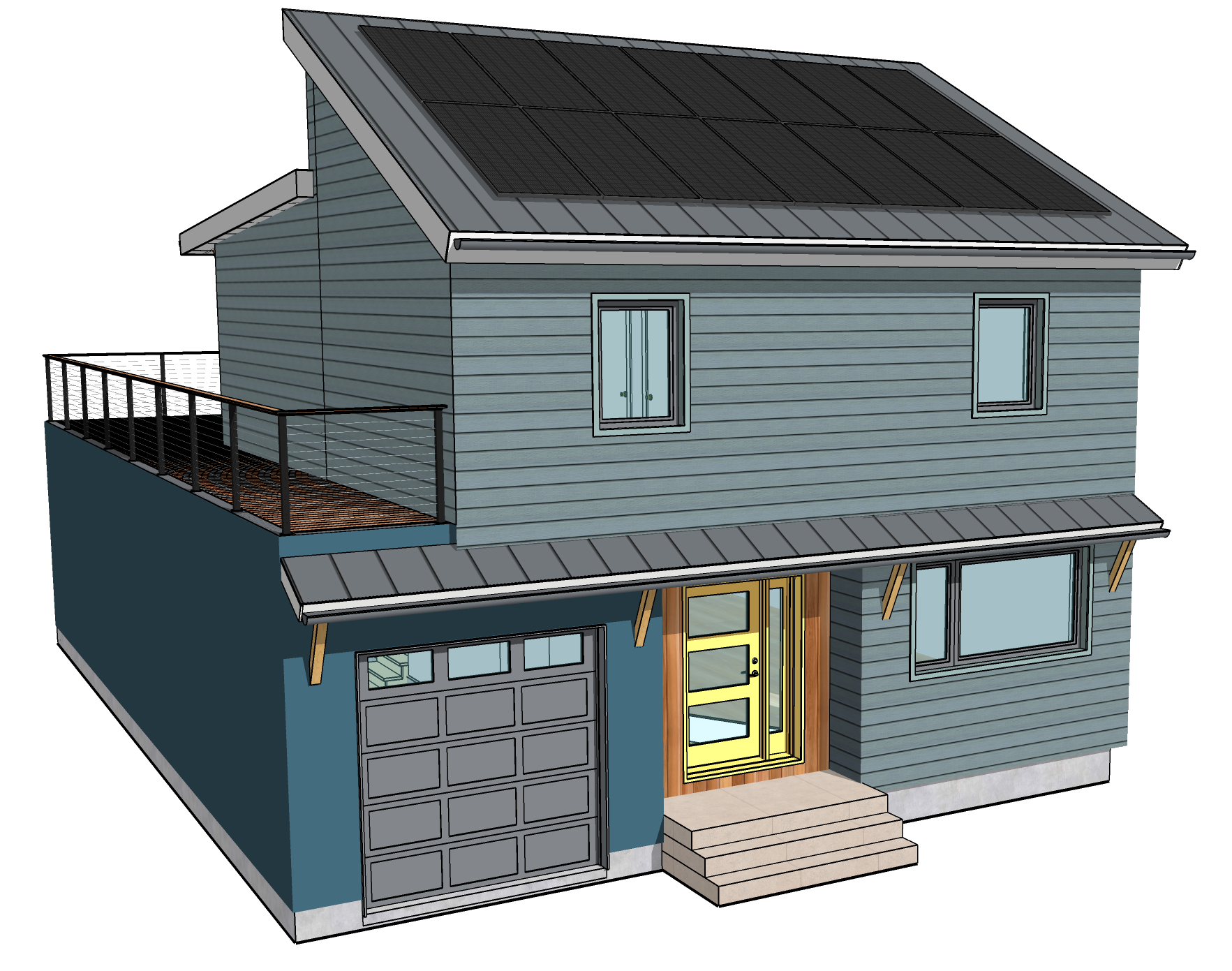
Clintonville Passive House is a new home build project. As Central Ohio’s first single family certified Passive House, this high performance home will far exceed typical standards of energy use, comfort, and durability. Being built on one of the last empty lots in a century old neighborhood, it seeks to make room for itself while respecting the existing neighborhood.
Passive house is a design and construction methodology for buildings that uses five core principles to enhance the energy efficiency, durability, health, resilience, and comfort of the finished product.
These five principles are:
- Continuous insulation without thermal bridging
- Extreme airtightness of the building envelope
- High-performance windows (in my case triple pane casements with low-E coatings) carefully arranged to take advantage of solar gains in winter and shade in summer
- Balanced heat/energy recovery ventilation system
- Minimal space conditioning equipment
Get more info on passive house from Phius here.
Another thing that makes this house stand out from many new home builds is its location. Clintonville is an established neighborhood in the city of Columbus, Ohio with many homes over a century old. There’s not much space left that hasn’t been built on here, and the space that is left is a little on the “tight” side. That makes this an urban infill project, with all the excitement and challenges that entails.
Finally, this project was designed, contracted, and built by its owner (that’s me). No doubt I had many contributions from a lot of skilled experts, sub-contractors, and friends (thank you!), but I’m the general contractor of record, and I did much work solo. That will includes framing the structure, roofing, installing windows and doors, insulating, painting, tiling, and more. It was a wild ride. I’m excited and eager to see the results. I hope you are too.
About Passive House
I think Passive House is possibly the best way around to achieve a higher degree of sustainability in our built world. That’s why I spend the time to earn my Certified Passive House Consultant (CPHC®) status with Phius (Passive House Institute US), which qualifies me to do design work on both residential and commercial buildings, new and retrofit. I don’t work for Phius, and my projects are my own, individual work. But Phius provides the framework for my approach to designing and building better.

From Phius:
The Phius passive building certification standard is a rigorous energy standard that produces buildings that use 40-60 percent less energy than conventional structures. The Phius standard is climate-specific, cost-optimized, and includes third-party quality assurance. Phius Certified Consultants have completed a comprehensive training course and passed a rigorous exam, which entitles them to use the Phius logo and the CPHC term.
The Phius Certified Consultant logo and CPHC® are used under license from Phius.
 Clintonville Passive House