
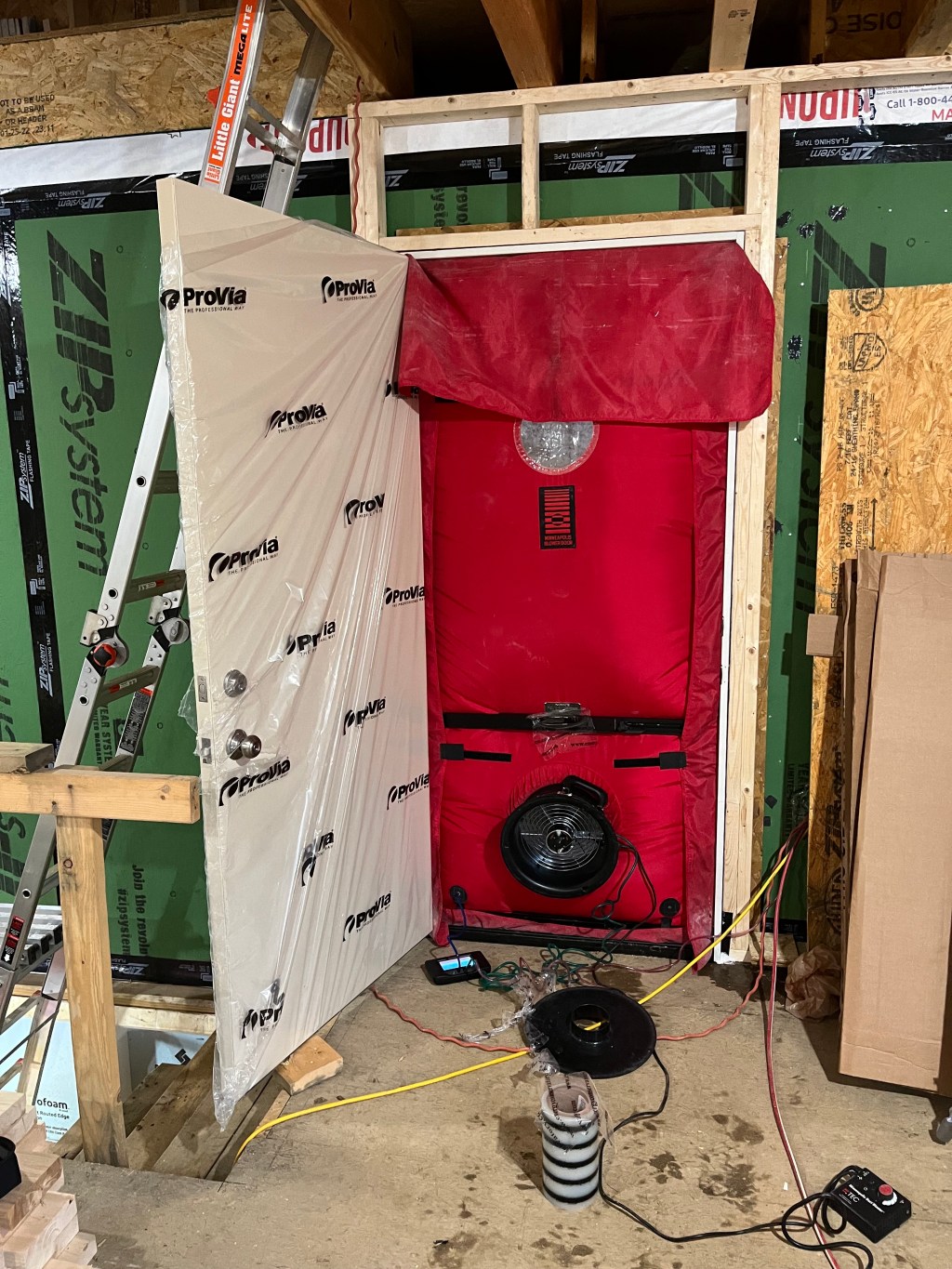
A while back, I wrote about one of the principles that makes a “passive” house just that. Proper thermal insulation is a crucial component that reduces energy consumption, provides thermal comfort to occupants, and reduces opportunities for mold growth and rot in the structure. The second principle is airtightness, and Clintonville Passive House underwent testing this past January to check whether the place is up to snuff.
Airtightness minimizes the unchecked flow of unconditioned outdoor air to the inside and indoor conditioned air out through walls, roofs, and floors. This is important because air carries with it thermal heat and also moisture in the form of water vapor. If cold outside air is coming through your walls, you may experience this as drafts and cold spots. And when warm air containing water vapor travels through a building enclosure there’s a chance for that vapor to change into liquid water inside walls if the temperature conditions are right (think warm, humid air going out through small holes in your wall when it’s below freezing outside—that water won’t make it all the way out as a gas). Airtightness has big ramifications for energy consumption and building durability.
So, to confirm my house has what it takes to keep conditioned air in and unconditioned air out, we set up a test that really sucks. Actually, it blows. Well, it does both. Enter the blower door!
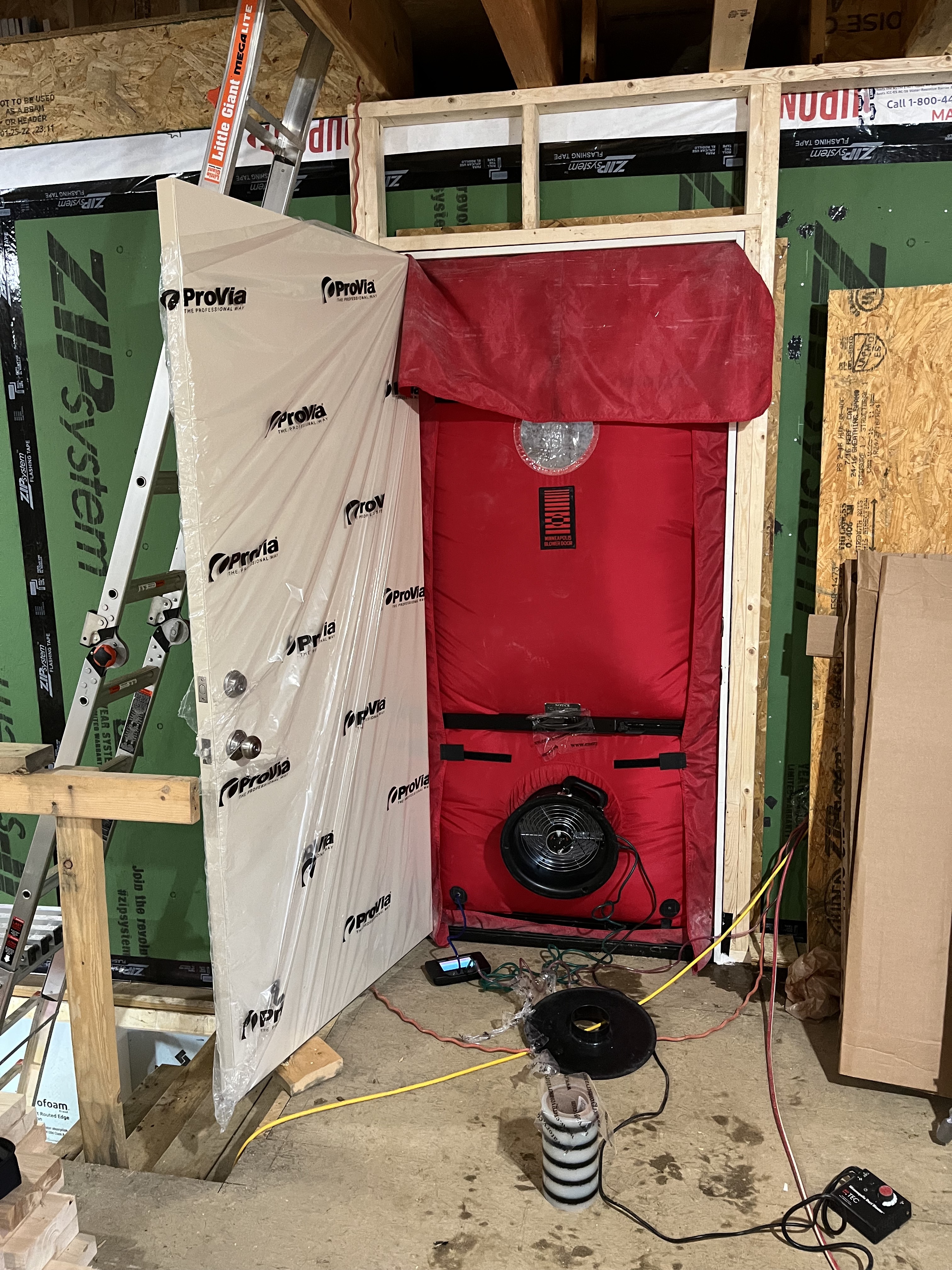
In this test, a fan is used to both pressurize and depressurize a building and measure the amount of air that leaks through in a given amount of time. This leakage rate is a measure of airtightness which can be compared to passive house requirements to tell me whether I pass the bar or not. I scheduled this first test just after the building envelope was fully enclosed with walls, roof, windows, and doors but before I completed plumbing, HVAC, and electrical installation or drywall. That way I have the opportunity to easily correct any problems before I get too far down the road. A final test at the end will verify performance for passive house certification.
Well, it’s good news for CPH. The average of my positive pressure and negative pressure tests came out around 110 CFM50. That’s 110 cubic feet per minute of airflow at a pressure of 50 Pascals. Given that my project’s target rate is 316 CFM50, I’m very pleased. For the performance rating nerds out there, that puts me at 0.021 CFM50 per square foot of envelope area, or 0.42 ACH50 (air changes per hour).
Given that code only requires a maximum of 5 ACH50, it’s clear that passive house is on an entirely different plane of performance in this aspect. Anecdotally, I’ve heard several accounts of older homes testing at over 10 ACH50 before remodels or energy retrofit projects. That amounts to 10 times the internal volume of a house leaking through the walls, roof, and floor in an hour. Or put another way, one entire volume of the house every six minutes! When you consider that a house of my size will contain nearly 15 gallons of water vapor (wow!) in the air at room temperature with 50% relative humidity, that wold be a lot of potential to end up with wet walls over the course of a winter in the worst case.
And if you’re thinking that all of this sounds a little over the top (after all, how could you possibly end up with that much pressure difference between indoors and outdoors, you may ask) consider that there are sources out there that estimate pressures far in excess of 50 Pascals during high winds and gusts, and there are ever-present, though smaller, pressure gradients on any building due to the so-called “stack effect” (essentially, hot air rises, creating pressure variations) and on buildings with exhaust-only ventilation systems or unbalanced HVAC systems.
Better to keep all that outside air out and inside air in.
Alright, enough hot air for one day. Thanks for reading!
 Clintonville Passive House
Leave a comment